
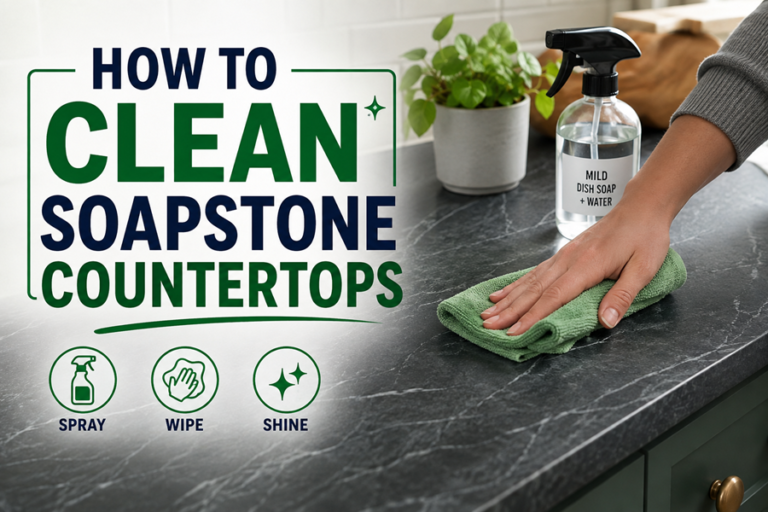
So you’ve got soapstone countertops. Or maybe you’re still deciding, still weighing it against granite and quartz, and you want to know what you’re actually signing up for on the cleaning side — basically, how to clean soapstone countertops without wrecking them. Good news — it’s a lot less complicated than most people assume. Anyone who’s dealt with resealing granite every year, or held their breath over a wine spill on marble, is going to find soapstone kind of refreshing.
Still, “low maintenance” doesn’t mean “zero maintenance.” There’s a right way to go about it, and honestly a few wrong ways too, though nothing catastrophic. This guide walks through how to clean soapstone countertops — the quick daily wipe, the deeper cleaning every week or two, plus stains, scratches, and that whole oiling debate people seem to have strong opinions about.
I’ll be honest, when I first went looking for real answers on this, most of what turned up online fell into two camps. Either it was overly technical — mineral density, quarry origin, stuff you don’t need to know to wipe down a counter — or it was so vague it wasn’t really answering anything (“just wipe it down!” thanks, very helpful). Neither one is much use when you’re standing in your kitchen wondering if the sponge you just grabbed was the wrong call. So this one skips the jargon and just tells you what actually works.
What Soapstone Actually Is (And Why It Cleans Differently)
Quick chemistry lesson, promise it’s short. Soapstone is a metamorphic rock, mostly talc, and that’s exactly where the soapy, smooth feel comes from — it’s not a coating or a finish, it’s just what the mineral itself feels like under your hand. Because of that mineral makeup, it’s naturally non-porous. Liquids sit on top rather than soaking in, which is the whole reason you’re not fighting stains here the way you would with granite or limestone.
It’s also chemically inert, which sounds fancy but really just means acids don’t bother it. Lemon juice, tomato sauce, red wine, straight vinegar — none of it etches soapstone the way it would chew into marble in about thirty seconds. That single fact is why a surprising number of serious home cooks switch over and never look back.
Of course there’s a catch, isn’t there. The trade-off is hardness. Soapstone sits softer than granite or quartz on the scale, so it picks up scratches more easily, and it darkens over time — a slow shift from pale gray toward deep charcoal, sometimes nearly black, especially around the sink and stove where hands and heat spend the most time. That darkening isn’t damage, by the way. People email asking if their counter is “ruined” and it’s almost always just… patina. Doing its thing. How you clean the stone early on just affects how evenly that color comes in.
One more wrinkle: not all soapstone is the same soapstone. The architectural-grade stuff used for countertops is denser than the soft, carving-grade soapstone you’d find at an art supply store for sculpting. Same mineral family, different purpose — the countertop version is selected specifically to hold up under knives, heat, and daily abuse. It’s still softer than quartz, though. That’s simply the deal you’re making in exchange for skipping sealant forever.
How to Clean Soapstone Countertops the Right Way
Here’s where people trip up. Since soapstone resists staining and skips the whole sealing requirement, it’s tempting to assume literally any cleaner is fair game. Not quite. Harsh degreasers, bleach, abrasive scrub pads — none of them will stain the stone exactly, but they’ll strip its natural oils and leave the surface looking dull, sometimes patchy in a way that’s genuinely hard to fix later. Ever seen a soapstone counter with weird lighter blotches next to darker areas? Nine times out of ten that’s inconsistent cleaning products at work, not some flaw baked into the stone.
So, short version: soapstone forgives a lot, but it’s not bulletproof, and “a little intention” really just means reaching for the right bottle under your sink instead of whatever’s closest.
How to Clean Soapstone Countertops Daily
For everyday spills, honestly, this is all you need:
- Damp microfiber cloth. Wipe crumbs, water rings, light grease — whatever’s there, as it happens rather than letting it sit.
- A few drops of mild dish soap, if grease is involved. Nothing special. Whatever’s already under your sink is fine.
- Dry it off. Water won’t stain soapstone if it sits there, but drying prevents streaks and just keeps things looking clean instead of hazy.
That’s genuinely it. Most people do this once or twice a day without thinking twice, and it’s the actual backbone of how to clean soapstone countertops — you don’t need a “big” cleaning session most of the time.
Got a busy kitchen — cooking every night, kids leaving cups on every flat surface? Keep a small spray bottle of diluted dish soap by the sink. Spray, wipe, move on. No measuring anything.
People ask sometimes whether hot water beats cold here. Not dramatically, though warm cuts through light grease a touch faster, which is probably why most folks default to it without really thinking about why. And unlike marble, there’s zero risk of “shocking” the stone with a temperature swing during cleaning — soapstone handles heat fine to begin with, so don’t overthink that part.
How to Clean Soapstone Countertops Deeply
Every so often the counters need more than a quick pass. Here’s roughly how I’d handle it:
- Clear the whole surface off. Appliances, dish rack, that one cutting board that never gets put away — all of it. Full access matters here.
- Warm water plus a bit of mild dish soap, or a pH-neutral stone cleaner if you’d rather buy something purpose-made.
- Wipe the entire surface, soft cloth or non-abrasive sponge, small circular motions.
- Rinse with plain water, separate clean cloth, to lift off leftover soap.
- Dry it completely with something lint-free.
Skip paper towels for this one — they shed lint, especially on honed or textured finishes, and picking fuzz off a counter you just cleaned is nobody’s favorite five minutes.
Give extra attention to the areas around the sink and stove. Those spots darken faster than the rest of the counter just from use, and staying on top of them with regular deep cleaning keeps the whole transition looking natural instead of blotchy. An old toothbrush works surprisingly well for seams and edges where grime likes to hide — cheap, disposable, does the job.
If you’ve got a farmhouse sink, or the sink itself is soapstone, pay a little extra mind to where counter meets sink. Water pools right at that seam, and while it won’t stain, hard-water deposits can build up and look chalky if you ignore it for a few weeks straight. A quick wipe with your soap solution handles it, no drama.
How to Clean Soapstone Countertops With Stains
Soapstone resists staining way better than most natural stone, but “resists” isn’t “immune,” especially if the surface has gone a stretch without any oil on it.
Light stains usually lift with a baking soda paste — mix baking soda with just enough water to make a thick paste, rub it onto the mark, let it sit ten or fifteen minutes, wipe clean with a damp cloth. It’s mildly abrasive, gentle enough that it won’t scratch, and it works on most everyday marks.
Grease and oil stains are kind of self-solving, which is nice. Because soapstone soaks up mineral oil as part of normal maintenance anyway, an oil-based stain often just blends right into the surrounding color once you oil that spot. Fresh grease mark? Dab mineral oil directly over it. Give it a day or two and it usually just disappears into the patina like it was never there.
Set-in, stubborn stains take a bit more work. Fine-grit sandpaper, 220-grit is a good starting point, buffs out the very top layer where the stain actually lives. Go easy — you’re removing a hair’s width of stone, not sanding through the counter. Follow up with mineral oil so the spot blends back in rather than looking like a bare patch.
Fixing Scratches (Yes, You Can Do This Yourself)
Honestly one of soapstone’s best-kept secrets. Being a softer stone, it scratches easier than granite, sure — but it’s also basically the only countertop material you can repair yourself at home without ever calling anyone.
- Sand the scratch lightly, 220-grit, small circular motions, going a bit past the edges of the mark so it blends rather than leaving a hard line.
- Wipe away the dust with a dry cloth.
- Apply mineral oil over the sanded spot — this is what brings the color back and merges it with everything around it.
- Deeper scratch? Start coarser, 120-grit, then finish with 220 for a smoother result.
Try that on granite or quartz and you’re on the phone with a stone restoration company. On soapstone it’s a fifteen-minute job you do while dinner’s in the oven.
The Oiling Question: Do You Really Need It?
Short answer, no. Soapstone darkens naturally over time from use, heat, and just being exposed to air — with or without oil ever touching it. But most soapstone owners do oil it anyway, because it speeds the darkening along and evens it out, plus it makes fresh scratches nearly disappear on contact.
How to oil soapstone countertops:
- Clean the surface, let it dry completely.
- Apply food-grade mineral oil with a soft, lint-free cloth.
- Rub it in evenly — don’t skip the edges.
- Let it sit 15–20 minutes.
- Wipe off whatever the stone didn’t absorb.
New installs usually want oiling every week or two for the first few months while the stone’s still “settling in,” so to speak. After that, once a month, sometimes every couple months, is plenty for most kitchens. Some people skip oil entirely and just let the stone age however it ages — totally fine, doesn’t affect durability either way. Really it just comes down to how badly you want that dark, charcoal look sooner rather than later.
One thing worth flagging: don’t overdo it. More oil isn’t better past a certain point. If the surface starts feeling tacky or greasy no matter how much you wipe, you’ve passed what the stone can actually take in — you’re just wiping off excess at that stage. Once it stops visibly darkening after each application, that’s your cue to space the oiling out further.
What to Keep Away From Your Soapstone
Short list, worth remembering:
- Steel wool or abrasive pads — leave fine scratches you’ll end up sanding out anyway.
- Bleach or ammonia cleaners — dry out the stone’s natural oils, leave things looking chalky.
- Heavy-duty degreasers — same problem, strip the patina unevenly.
- Frequent vinegar or citrus cleaning — soapstone resists etching, sure, but repeated acid exposure over years can still dull it.
- Water sitting for long stretches — not really damaging, but can leave temporary light spots that take a bit to blend back.
Supplies Worth Keeping on Hand
- Microfiber cloths
- Mild dish soap
- Food-grade mineral oil
- Baking soda
- 220-grit and 120-grit sandpaper
- A spray bottle for diluted soap
Honestly, once you know how to clean soapstone countertops with just these basics, you don’t need specialty “soapstone cleaner” products — though they do exist if you’d rather just buy something pre-made and not think about it. If you go that route, check the label’s pH-neutral and free of bleach, ammonia, citrus acids. Keeping this stuff together under the sink turns the whole thing into a two-minute habit instead of a chore you have to plan around. Some people keep a little designated basket just for these items so there’s never an excuse to grab the wrong bottle when you’re in a rush.
Long-Term Habits That Actually Make a Difference
Use trivets, even though you technically don’t have to. Soapstone handles heat well, but repeated thermal shock — hot pan straight off the burner, every single time, for years — can occasionally contribute to hairline cracks. Rare, but it’s a free habit to build.
Let the patina happen. Don’t fight the darkening. It’s genuinely what makes soapstone look better with age rather than worse, which honestly isn’t true of most countertop materials out there.
Deal with scratches when you spot them, not three months later. Takes fifteen minutes now versus a more tedious session once several marks have piled up.
Re-oil after any repair. Sanded out a stain or a scratch? Finish with mineral oil so the spot blends instead of sitting there as an obvious lighter patch.
Keep a loose log if you’re that type of person. Sounds excessive, I know, but plenty of soapstone owners just jot a quick note on their phone whenever they oil the counters. Not necessary, but it helps you figure out your own rhythm — maybe your kitchen actually needs oiling every three weeks, or maybe six weeks works fine. You won’t know until you track it a little.
FAQs on How to Clean Soapstone Countertops
Can I clean soapstone with just soap and water every day? Yes — genuinely the recommended method. Nothing fancier needed for daily use.
Is oiling soapstone countertops required? Nope. Optional. Mainly speeds up the natural darkening. Skipping it doesn’t hurt the stone at all.
Is soapstone harder to maintain than granite? Different, not harder. Zero sealing, ever — but it’s softer, so it scratches a bit easier and benefits from the occasional oiling if you want that even, dark look.
Can I use vinegar on soapstone? Better to avoid making it a habit. Won’t etch the way it does on marble, but frequent acid exposure can dull the finish given enough time.
Will hot pots crack my soapstone counter? Very unlikely. It’s naturally heat-resistant, though trivets are still a smart habit for long-term peace of mind — costs nothing to be a little careful.
Can an old, neglected soapstone counter be restored? Almost always. A light sanding plus a generous coat of mineral oil brings back most of the original richness, even after years of zero maintenance.
Does soapstone need professional cleaning or resealing like granite? No — and this is one of the biggest reasons people choose it. No sealant, ever, to reapply. Everything in this guide is something any homeowner can handle without hiring a single person.
The Bottom Line
Once it clicks, how to clean soapstone countertops stops being a question you have to look up and just becomes muscle memory. Wipe daily. Deep clean every week or two. Oil it if you want that dark patina sooner. Sand out whatever scratches. It’s one of the few countertop materials that actually gets more forgiving the better you understand it — no sealants to worry about, no panic every time someone squeezes a lemon nearby, and repairs you can do yourself in less time than it takes water to boil for pasta.
Stick with a routine and soapstone pays you back with a counter that looks better every single year, not worse. And on the days you slip — an overlooked spill, a scratch from shoving an appliance across the counter — remember that soapstone’s whole thing is forgiving those moments. Most “oops” situations here end in a fifteen-minute fix, not a phone call to a stone restoration company.