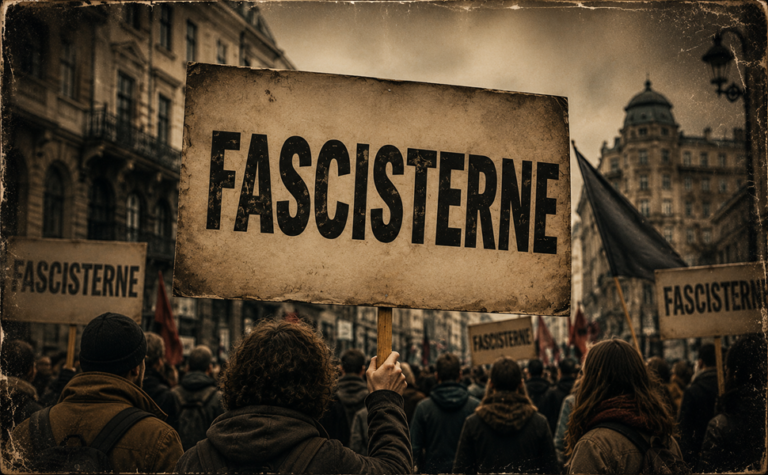
Picture your neighbor for a second. The guy who waves every morning, fixes his own fence, brings soup over when you’re sick. Now picture him quietly writing your name down for an occupying army, because in his head that’s the only way to keep his own family safe. Sounds like a movie plot. It isn’t. It happened, over and over, in Denmark during the Second World War, and history left behind exactly one word for people like him. Fascisterne.
Small word. Six syllables, give or take. But there’s something genuinely uncomfortable sitting underneath it, and it’s this: fascism doesn’t actually need monsters to spread. It just needs people who go quiet at the right moment. Or the wrong one. Depends who you ask, I guess.
So what does the word actually mean, where’d it come from, how did it play out in Denmark specifically, and, this is the bit almost every article online conveniently skips, why does the same basic playbook keep showing up today, just with nicer graphics? Let’s get into it.
What Does Fascisterne Actually Mean?
Fascisterne is Danish for “the fascists.” Not fascism as some floating idea in a textbook somewhere. The fascists. Actual people. Plural, definite, nowhere to hide in the abstract.
That distinction matters more than it sounds like it should, honestly. Danish grammar sort of forces the specificity on you whether you want it or not. When people said Fascisterne during the occupation, they weren’t gesturing vaguely toward Rome or Berlin. They meant the man down the street who’d joined the Danish Nazi Party. The police officer handing over lists of names. The newspaper editor quietly softening his own headlines because upsetting the Germans just wasn’t worth the trouble that particular week.
Fascisterne has a face, basically. And that’s really what separates it from the English word “fascism,” which tends to stay comfortably theoretical right up until someone forces it not to.
Where the Word Comes From, and Why the Root Actually Matters
Trace it back far enough and you land on the Italian word fascio, meaning bundle. It’s a nod to the fasces, an old Roman symbol, a bunch of rods tied together, sometimes with an axe blade poking out the side. Not exactly subtle, even for the Romans. One stick snaps easy enough. A bundle doesn’t. Tie enough of them together and you get strength, plus a threat that isn’t hiding very hard behind it.
Mussolini basically built his whole political brand on that one image. Individuals alone are weak, he argued. A nation bound tight under one leader, unbreakable. Denmark folded the term into its own language not long after, fascisme for fascism, fascist for one fascist, Fascisterne for the group of them together, and it just kind of stuck around.
April 9, 1940: The Morning the Word Stopped Being Theory
Around 4:15 in the morning on April 9, 1940, German troops crossed into Denmark. Military resistance lasted maybe two hours, and that was mostly on purpose. The Danish government looked at the odds and chose to avoid a massacre it had basically zero chance of winning. What followed was strange, almost too calm for what it actually was. Denmark ended up the only occupied country allowed to hang onto its own government, its own king, its own police, for close to three years.
Historians sometimes call this the “model protectorate.” Worth sitting with that for a second, because it created a country where collaboration and resistance grew up right next to each other, out in the open, among people who genuinely knew one another.
Danish farmers kept shipping food to Germany under official trade deals. Police cooperated, at least early on, mostly just to keep some kind of order going. A loud but fairly small minority signed up for Fascisterne groups outright, the DNSAP being the big one, hoping German patronage might finally hand them real power. Underneath all of it, quietly, a resistance was already taking shape. Illegal newspapers. Sabotage on the rail lines. Weapons smuggled in from wherever anyone could scrounge them up.
That balance held until August 1943, when it just snapped. Strikes and sabotage pushed Germany into declaring martial law and dissolving the Danish government outright. Pretense over, basically. After that, whether you counted yourself among Fascisterne or against them wasn’t background noise anymore. It was something you had to decide, pretty much daily, and everyone knew everyone else was watching.
The Ideology Behind the Word
Strip off the uniforms and the slogans and what’s left underneath is a belief system that kept repeating the same handful of ideas, country after country. Nation before individual, always. Your rights, your opinions, even your own safety, matter less than loyalty to the state. One leader, and not the kind you vote out either, more like the living embodiment of the nation itself. There’s always an enemy too, because the whole machine needs someone to blame for something.
Jews, communists, resistance fighters, “traitors,” whoever’s convenient that particular week. And violence isn’t some accident of the system. It’s policy. The Blackshirts in Italy, the SS in Germany, these weren’t rogue units freelancing on their own. They were the enforcement arm the whole ideology needed just to keep running smoothly.
Here’s the genuinely unsettling part, if you spend any real time reading into it: how boring the actual machinery looked from the inside. Filing cabinets. Train timetables. Census data. The Holocaust ran on bureaucracy just as much as it ran on raw hatred, and honestly that might be the single most disturbing thing Fascisterne history has to offer anyone willing to actually sit with it for a minute.
The Rescue Denmark Is Actually Known For
Here’s a part most competing articles either skip entirely or brush past in a single sentence. Probably because it complicates the tidy story of a country full of quiet collaborators.
In October 1943, Germany ordered the deportation of Denmark’s roughly 7,800 Jewish citizens. Word leaked out ahead of time, partly through a German diplomat named Georg Duckwitz, who tipped off Danish officials. What happened over the next three weeks or so is one of the only rescue operations of that scale anywhere during the entire war, and it doesn’t get talked about nearly enough outside of Denmark itself.
Fishermen. Doctors. Students. Total strangers. Ordinary Danes pulled together a mass smuggling effort across the narrow strait to neutral Sweden, mostly in small fishing boats, mostly at night, mostly at real personal risk to themselves. Something like 7,200 Jews and 700 non-Jewish family members made it across. Fewer than 500 Danish Jews got caught and were sent to Theresienstadt, and even then, continued pressure from Danish authorities is credited with keeping their survival rate unusually high compared to almost anywhere else in occupied Europe.
Put that next to the collaborators and something shifts. Fascisterne stops being a distant history lesson and starts feeling more like a mirror, kind of an uncomfortable one. Every occupied society had both kinds of people in it, the ones who looked away and the ones who ran toward the risk. History doesn’t really care which side was bigger, not really. It just keeps asking which one you’d have actually been.
Fascisterne vs. the Resistance, Fought Partly With Printing Presses
By 1943, tens of thousands of Danes were tangled up in some form of resistance work. Sabotage cells, intelligence networks quietly feeding tips back to Britain, and an underground press that, at its peak, was apparently outselling the official, censored newspapers. Wild, if you actually stop and think about it.
That detail rarely shows up in other write-ups on this topic, and it probably should. Information itself was a battlefield. Every illegal newspaper passed hand to hand was a small, direct refusal of the fear fascism needs to keep functioning. Fascist control basically runs on silence. That’s the whole trick. The resistance’s sharpest weapon, most of the time, wasn’t dynamite. It was just people who flat out refused to shut up.
Mussolini, Hitler, Quisling, the Names Attached to the Word
No real conversation about Fascisterne skips past these three. Benito Mussolini founded Italian fascism in 1919, and nearly every fascist movement that followed copied his template, black-shirted paramilitaries, theatrical rallies, the whole package.
Adolf Hitler took that same basic ideology and fused it with a genocidal racial theory, turning Germany into the most destructive fascist state the world has probably ever seen. And Vidkun Quisling, who led Norway’s fascist party and headed a puppet government under Nazi occupation, became such a symbol of betrayal that his own surname turned into an actual English word for “traitor.”
Worth flagging, Denmark’s homegrown Fascisterne never actually seized power outright. The DNSAP polled somewhere around 2 to 3 percent even during the occupation years, which honestly isn’t much. That failure doesn’t get talked about enough, because it complicates the idea that fascism only wins through popular vote. It doesn’t need to win an election at all. A small, well-placed group working alongside an occupying army can end up causing more damage than a party that actually wins one fair and square.
Fascisterne vs. Other Authoritarian Ideologies
People lump all authoritarian systems together sometimes, and it’s worth pulling them apart for a second, because Fascisterne wasn’t the only game in town back then.
Communism, on paper anyway, promised a classless society where the state would eventually wither away once real equality got reached. Fascism never pretended that, not for a second. It wanted the state stronger, not weaker, and it treated class conflict as something to crush rather than resolve. Communist regimes leaned on economic ideology first, control second. Fascist regimes leaned on nation and race first, and treated economics as whatever tool got them there fastest.
Plain old military dictatorships are closer cousins, but even they’re missing a piece somehow. A general who seizes power usually just wants order and control, not some sweeping cultural revolution. Fascisterne-style regimes wanted total transformation, a new kind of citizen, a new kind of loyalty, backed by mass rallies and propaganda machinery most military juntas never really bothered building in the first place.
None of these categories are perfectly clean, and historians argue about the edges constantly, but the shorthand mostly holds up: communism reorganizes class, military juntas just want control, fascism remakes an entire nation’s identity around one leader and one enemy.
What Happened to Fascisterne After 1945
When the war ended, Denmark didn’t just move on and pretend the previous five years hadn’t happened. Between 1945 and 1947, roughly 40,000 people got investigated for collaboration in what became known as the retsopgøret, the “legal reckoning.” Around 13,500 were convicted. 46 death sentences were carried out, which is a genuinely heavy number for a country Denmark’s size.
None of it went uncontested either. Some Danes thought the trials went too far. Others thought too many people slid through with light sentences for compromises they’d made just to stay alive. That tension, between justice and mercy, between judging people fairly and judging them at all, is something historians still argue about today, and probably always will.
Why Fascisterne Still Matters in 2026
Here’s the part almost nobody writing about this keyword actually bothers getting specific about. Political scientists who study democratic backsliding, a term groups like Freedom House and the V-Dem Institute use for countries slowly losing their democratic protections, point to warning signs that echo the old Fascisterne playbook pretty closely.
Attacks on independent courts and journalists, framed as “protecting the nation” from enemies within. A leader who positions himself as the only person capable of actually saving the country. Minority groups or immigrants blamed for problems that are usually a lot more economic than anything else. Paramilitary-style groups, or these days just online mobs, used to intimidate critics instead of formal state violence.
None of that means every political argument today is fascism, to be clear, and it’s worth saying that outright. Historians are pretty quick to warn against throwing the word around carelessly, since overusing it just drains the meaning right out of it. But understanding the actual mechanics behind Fascisterne, fear first, propaganda second, violence somewhere down the line, gives ordinary people something closer to a real early-warning system. Not just a scary label to fling at whoever they happen to disagree with that day.
How Democracies Guard Against a Fascisterne-Style Drift
Knowing the warning signs is one thing. Actually holding the line is another, and this is the part most Fascisterne articles skip entirely, probably because it’s a lot less dramatic than talking about tanks and rallies.
An independent judiciary matters more than people usually give it credit for, since courts that can actually rule against a government are the first thing authoritarian movements try to weaken. A free press does something similar from a different angle, it just makes hiding abuses of power a lot harder than it’d otherwise be. Term limits sound boring until you remember “the leader can never be replaced” is basically step one of the old Fascisterne playbook. And civic education, simply teaching people what this stuff actually looked like last time around, ends up mattering more than any single law sitting on the books.
Denmark leaned on something less official but arguably just as strong: a culture where informal social pressure made collaboration genuinely shameful, and where enough ordinary people were willing to take real risks for neighbors they barely even knew. Laws help, sure. But laws didn’t save those 7,200 people crossing to Sweden back in October 1943. People did that, plain and simple.
Quick Reference: Fascisterne at a Glance
| Element | Detail |
| Literal meaning | “The fascists” (Danish, definite plural) |
| Root word | Italian fascio (“bundle”), tied to the Roman fasces symbol |
| Danish occupation began | April 9, 1940 |
| Occupation turned direct/military | August 29, 1943 |
| Danish Jews rescued to Sweden | Roughly 7,200 people, October 1943 |
| Post-war collaborators investigated | About 40,000 (1945 to 1947) |
| Most infamous Nordic collaborator | Vidkun Quisling (Norway) |
Frequently Asked Questions About Fascisterne
What does Fascisterne mean in English? It means “the fascists.” A Danish word for people who supported or actively collaborated with fascist and Nazi authority, most often used when talking about occupied Denmark during World War II.
Is Fascisterne only a historical term, or is it still used today? Bit of both, honestly. Historians mostly reserve it for WWII-era Denmark specifically, though it does get applied more loosely today in political commentary now and then, a habit a lot of historians actually caution against, since it can blur what the word originally meant.
Did Denmark have its own fascist party? Yes, the DNSAP, or Danmarks Nationalsocialistiske Arbejderparti. It never pulled more than around 2 to 3 percent of the national vote, even at the height of the occupation.
What’s the difference between Fascisterne and Nazism? Fascism is the broader ideology, nationalist, authoritarian, anti-democratic at its core. Nazism is Germany’s own extreme version of it, with a racial pseudoscience bolted on top that pushed things toward genocide. Denmark’s Fascisterne generally aligned with and supported Nazi Germany rather than building something entirely separate.
Why is Denmark’s story around Fascisterne considered unusual? Because collaboration and resistance existed side by side in the same small country, at the same time, among people who actually knew each other. That includes one of the more successful civilian rescue operations of Jewish citizens anywhere in occupied Europe.